What Is the OPCW? The Global Institution Behind the Chemical Weapons Ban
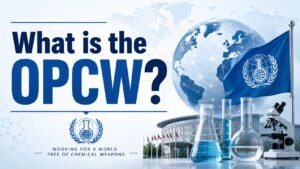
The Organisation for the Prohibition of Chemical Weapons, better known as the OPCW, is the international body responsible for implementing the Chemical Weapons Convention.
At its simplest, the OPCW exists to make sure chemical weapons are not developed, produced, stockpiled, transferred, or used. But that simple definition understates its importance.
The OPCW is not merely a diplomatic forum. It is a verification organization. It translates a global legal ban into inspections, declarations, laboratory analysis, investigations, technical assistance, and compliance procedures.
In foreign policy terms, the OPCW is one of the most important arms control institutions created after the Cold War. It is built around a rare idea in international security: an entire category of weapons of mass destruction should not just be regulated, but abolished.
That mission makes the OPCW both technical and political. Its inspectors work with chemistry, sampling protocols, industrial facilities, and chain-of-custody procedures. Its governing bodies deal with state sovereignty, war, deterrence, accountability, and great-power rivalry.
The OPCW’s work is often invisible when it succeeds. Chemical weapons are not supposed to be normal instruments of war. They are supposed to remain taboo. The OPCW is one of the institutions that helps keep that taboo alive.
Executive Summary
The OPCW is the implementing body of the Chemical Weapons Convention, the treaty that bans chemical weapons worldwide.
Its main responsibilities are to verify the destruction of chemical weapons, inspect relevant chemical facilities, investigate alleged chemical weapons use, assist countries threatened by chemical attacks, and promote the peaceful use of chemistry.
The organization was established in 1997, when the Chemical Weapons Convention entered into force. It is headquartered in The Hague, Netherlands.
Its membership is nearly universal. Almost every country in the world has joined the Chemical Weapons Convention, which gives the OPCW a broad mandate and unusual legitimacy compared with many other arms control regimes.
The OPCW has achieved one of the most significant milestones in modern disarmament: the verified destruction of all declared chemical weapons stockpiles. That achievement does not mean the chemical weapons problem is solved. It means the first major phase of the treaty’s mission was completed.
The organization’s future challenge is different from its original one.
The early OPCW focused heavily on declared Cold War-era stockpiles. The current OPCW must deal with undeclared weapons, battlefield allegations, toxic chemicals used by non-state actors, industrial dual-use risks, and the political difficulty of enforcement in a divided international system.
That makes the OPCW a case study in the strengths and limits of international law. It can verify. It can investigate. It can expose. It can assist. It can help build national capacity. But it cannot enforce the chemical weapons ban on its own. Enforcement ultimately depends on states.
What Is the OPCW?
The OPCW is an international organization created to implement the Chemical Weapons Convention.
Its full name is the Organisation for the Prohibition of Chemical Weapons. The organization uses the British spelling “Organisation,” which is why the acronym is OPCW rather than OPCW based on the American spelling.
The OPCW’s basic purpose is to eliminate chemical weapons and prevent their return.
It does this through several overlapping functions:
- It verifies the destruction of chemical weapons stockpiles.
- It monitors chemical weapons production facilities and destruction facilities.
- It receives and reviews declarations from member states.
- It inspects certain chemical industry sites.
- It investigates allegations of chemical weapons use.
- It provides assistance and protection to countries threatened by chemical attacks.
- It promotes international cooperation in peaceful chemistry.
- It supports national implementation of the Chemical Weapons Convention.
The OPCW is not a military alliance. It is not an intelligence agency. It is not a court. It does not have its own police force.
Its power comes from the treaty system behind it. Member states accept legal obligations under the Chemical Weapons Convention. The OPCW then provides the institutional machinery to verify and support those obligations.
This machinery matters because chemical weapons are unusually difficult to govern.
Many dangerous chemicals also have legitimate industrial, medical, agricultural, and research uses. A chemical weapons regime cannot simply ban chemistry. It has to distinguish between lawful and unlawful purposes. It must monitor risk without paralyzing peaceful industry.
That is the central tension at the heart of the OPCW’s mission.
Why the OPCW Exists
The OPCW exists because chemical weapons occupy a special place in the history of modern war.
Chemical warfare became infamous during World War I. Chlorine, phosgene, and mustard gas caused mass casualties and left a lasting moral scar. Soldiers were blinded, burned, suffocated, and psychologically traumatized by weapons that were difficult to control and horrifying in their effects.
The first major international response was the 1925 Geneva Protocol. It prohibited the use of chemical and biological weapons in war. But it had major weaknesses. It did not ban production. It did not ban possession. It did not create a verification system. It did not eliminate stockpiles.
As a result, chemical weapons remained part of many national arsenals for decades.
During the Cold War, the United States, the Soviet Union, and other states maintained large chemical weapons programs. Chemical weapons were viewed by some governments as battlefield weapons, deterrents, or tools of asymmetric warfare.
The Chemical Weapons Convention was designed to go further than the Geneva Protocol. It banned not only the use of chemical weapons, but also their development, production, acquisition, stockpiling, retention, and transfer.
This was a major conceptual shift.
The treaty did not merely stigmatize chemical weapons. It required their destruction.
The OPCW was created to make that destruction verifiable.
The Chemical Weapons Convention: The OPCW’s Legal Foundation
The Chemical Weapons Convention is the legal foundation of the OPCW.
The treaty bans chemical weapons and requires member states to destroy any chemical weapons they possess. It also requires states to destroy chemical weapons production facilities or convert them under strict conditions for peaceful purposes.
The Convention is built around a comprehensive prohibition.
States that join the treaty agree not to develop, produce, acquire, stockpile, retain, transfer, or use chemical weapons. They also agree not to assist, encourage, or induce anyone else to engage in prohibited activities.
This matters because a chemical weapons program is not just a weapon sitting in storage.
It can involve research, precursor chemicals, production equipment, munitions, delivery systems, storage sites, trained personnel, and concealment networks. A meaningful ban must cover the whole system.
The treaty also includes verification measures. These include state declarations, inspections, data reporting, and mechanisms for addressing compliance concerns.
The OPCW is the organization that administers this system.
In practice, that means the OPCW is the operational arm of the chemical weapons ban. The treaty provides the law. The OPCW provides the institutional structure that makes the law more than a promise.
What Counts as a Chemical Weapon?
A chemical weapon is not defined only by the name of a chemical.
Under the Chemical Weapons Convention, the definition is broader and more functional. It includes toxic chemicals and their precursors, except when they are intended for permitted purposes and used in quantities consistent with those purposes.
This is often called the “general purpose criterion.”
The general purpose criterion is important because many chemicals can be used for both lawful and unlawful purposes.
A chemical used in agriculture, manufacturing, medicine, or research may be legal in one context and illegal in another. The key questions are purpose, quantity, and consistency with permitted use.
A chemical weapon can include:
- A toxic chemical used to cause death or harm.
- A precursor chemical used to make a toxic agent.
- A munition or device designed to deliver a toxic chemical.
- Equipment specifically designed for use with chemical munitions or devices.
This broad definition is necessary because a narrow list-based approach would be easy to evade.
A state or actor could modify a chemical, use an unscheduled substance, or exploit industrial materials not commonly associated with classic chemical warfare agents. The general purpose criterion helps close those loopholes.
It also makes the OPCW’s job more complicated.
The organization must monitor risk without treating ordinary chemistry as suspicious by default. That requires technical expertise, legal clarity, and cooperation with national authorities and industry.
The OPCW’s Core Mission
The OPCW’s work can be understood through five major missions.
1. Eliminating Existing Chemical Weapons
The original disarmament task was to verify the destruction of declared chemical weapons stockpiles.
This involved enormous logistical, technical, environmental, and political challenges.
Chemical weapons are dangerous to store and dangerous to destroy. Some are old and unstable. Some are contained in munitions that have degraded over time. Some require specialized destruction facilities. Destruction must protect workers, nearby communities, and the environment.
The OPCW’s role is not simply to accept a state’s word that weapons were destroyed. It verifies destruction through declarations, inspections, monitoring, documentation, and technical procedures.
The destruction of declared stockpiles is one of the OPCW’s central achievements. It represents a rare case in which an entire class of declared weapons of mass destruction was not only banned, but verifiably eliminated.
2. Preventing the Re-Emergence of Chemical Weapons
The second mission is prevention.
Chemical weapons can re-emerge in several ways. A state might hide undeclared stockpiles. A government might rebuild a prohibited program. A non-state actor might acquire toxic chemicals. A criminal group or terrorist organization might use industrial chemicals as weapons. A research breakthrough might lower the barrier to misuse.
Prevention therefore requires more than watching old weapons depots.
It requires a system that tracks relevant chemicals, monitors certain facilities, encourages national controls, and supports scientific awareness.
The OPCW receives declarations from member states about chemical activities covered by the treaty. It conducts inspections at declared facilities. It also works with states to strengthen national laws, customs controls, emergency preparedness, and chemical safety practices.
This is the quiet side of nonproliferation.
The goal is not only to catch violations after they happen. It is to reduce the chance that violations become possible in the first place.
3. Verifying Chemical Industry Compliance
The OPCW’s work extends into the civilian chemical industry.
This is one reason the chemical weapons regime is more complex than many people assume. Modern economies depend on chemicals. Fertilizers, plastics, pharmaceuticals, pesticides, solvents, and industrial inputs all involve chemical production.
Some chemicals relevant to the treaty have legitimate commercial uses. Others may be precursors to toxic agents. Some facilities may have capabilities that could theoretically be misused.
The OPCW inspection system is designed to confirm that chemical activities are consistent with the treaty.
This does not mean every chemical plant is treated like a weapons site. The treaty uses schedules and categories to identify chemicals and facilities of concern. It also includes protections for confidential business information.
Still, industry verification is central to the regime.
Chemical disarmament cannot succeed if it only focuses on military stockpiles. The industrial base matters too.
4. Investigating Alleged Chemical Weapons Use
The OPCW can investigate allegations of chemical weapons use.
This role has become more prominent in the twenty-first century, especially after chemical attacks in Syria and allegations in other conflicts.
Investigations may involve interviews, site visits, biomedical samples, environmental samples, munition remnants, medical records, witness testimony, and laboratory analysis. The credibility of this work depends on technical rigor and chain-of-custody procedures.
The OPCW’s investigative role is politically sensitive.
When chemical weapons are allegedly used in war, the question is not only scientific. It becomes diplomatic, military, legal, and moral. A finding that chemical weapons were used can trigger international condemnation, sanctions, military debate, or proceedings in other forums.
The OPCW is therefore expected to operate with scientific neutrality in highly politicized environments.
That is difficult. But it is also why the organization matters.
Without a credible technical body, chemical weapons allegations would be left entirely to propaganda, intelligence claims, and competing state narratives.
5. Assistance, Protection, and Peaceful Chemistry
The OPCW also helps member states prepare for and respond to chemical threats.
This includes training, emergency response support, protective equipment knowledge, detection capacity, and assistance planning. A state that is threatened by chemical weapons or attacked with them can request help through the treaty framework.
The organization also promotes peaceful uses of chemistry.
This part of the OPCW’s mandate is important for political legitimacy. The treaty is not intended to block scientific development or peaceful chemical trade. It is meant to prevent misuse.
For many countries, especially developing states, the value of the OPCW is not only disarmament. It is also training, capacity building, laboratory support, chemical safety, and access to peaceful scientific cooperation.
This balance is central to the Chemical Weapons Convention.
The treaty prohibits chemical weapons. It does not prohibit chemistry.
How the OPCW Is Governed
The OPCW has three principal organs: the Conference of the States Parties, the Executive Council, and the Technical Secretariat.
Each plays a different role.
The Conference of the States Parties
The Conference of the States Parties is the OPCW’s main plenary body.
All member states are represented. Each state has one vote.
The Conference oversees implementation of the Chemical Weapons Convention. It approves the budget, elects members of the Executive Council, appoints the Director-General, reviews compliance, and considers major policy questions.
In political terms, the Conference is where the treaty community speaks collectively.
It is also where disagreements become visible. Chemical weapons issues often involve war, attribution, sovereignty, sanctions, and intelligence. Member states do not always agree on how to interpret events or how forcefully to respond.
The Executive Council
The Executive Council is a smaller governing body.
It supervises the Technical Secretariat and handles many regular implementation and compliance matters. Its members are elected by the Conference and distributed by regional groups.
The Council is important because it sits between the broad political membership and the technical work of the Secretariat.
It reviews reports, considers compliance concerns, and can recommend action to the Conference. It is often where sensitive disputes are debated before they reach the full membership.
The Technical Secretariat
The Technical Secretariat is the professional body that carries out the OPCW’s day-to-day work.
It includes inspectors, scientists, legal experts, analysts, administrators, and other specialists. It receives declarations, conducts inspections, organizes investigations, supports assistance programs, and prepares reports.
The Technical Secretariat is essential because the OPCW’s credibility depends on expertise.
Chemical weapons verification is not a symbolic exercise. It requires technical competence, secure procedures, disciplined documentation, and scientific independence.
The Secretariat is where treaty language becomes operational reality.
The Director-General
The OPCW is led by a Director-General.
The Director-General manages the Technical Secretariat and represents the organization in many diplomatic settings. The role requires both administrative and political skill.
The Director-General must protect the technical credibility of the organization while working with member states that may disagree sharply with one another. That balance is not easy.
The OPCW’s authority depends on trust. If states believe the Secretariat is politicized, the institution suffers. If the Secretariat avoids difficult findings to preserve consensus, the treaty suffers.
The Director-General therefore operates in a narrow space between technical independence and diplomatic accountability.
Membership and Universality
The Chemical Weapons Convention is one of the most widely accepted arms control treaties in the world.
Nearly every country has joined. This broad membership gives the OPCW a strong claim to represent a global norm, not just a regional or ideological bloc.
Universality matters for several reasons.
First, chemical weapons threats are not confined to one region.
Second, the chemical industry is global. Chemicals, equipment, expertise, and precursors can cross borders.
Third, a prohibition is strongest when there are few safe havens outside it.
The remaining states outside the treaty matter precisely because the treaty is otherwise so widely accepted. Non-membership creates gaps in the global regime.
For the OPCW, universality is not just a diplomatic slogan. It is a security objective.
The fewer states outside the Chemical Weapons Convention, the harder it becomes for chemical weapons programs to hide behind legal ambiguity.
The Verification System
The OPCW’s verification system is the core of its value.
International law often depends on promises. Arms control requires proof.
The Chemical Weapons Convention requires states to declare relevant weapons, facilities, chemicals, and activities. The OPCW reviews these declarations and conducts inspections to verify compliance.
This system includes several types of inspections.
Some relate to chemical weapons destruction. Others relate to former production facilities. Others involve chemical industry sites. In serious cases, the treaty also provides for challenge inspections and investigations of alleged use.
The verification system has several important features.
Declarations
Member states must provide information about treaty-relevant activities.
Declarations create the baseline for verification. Without them, inspectors would not know what a state claims to possess, produce, destroy, or operate.
A declaration is not proof by itself. But it creates a record against which inspections and later information can be compared.
Routine Inspections
Routine inspections help confirm that declared activities match treaty obligations.
These inspections are especially important for chemical weapons destruction facilities and certain chemical industry sites.
Routine verification is not as dramatic as crisis investigation. But it is central to prevention.
A treaty that only reacts after chemical weapons are used is weaker than one that continuously monitors risk.
Challenge Inspections
The Chemical Weapons Convention includes a challenge inspection mechanism.
In principle, one member state can request an inspection of another state’s facility or location to clarify compliance concerns. The treaty was designed to make refusal difficult.
Challenge inspections are politically sensitive. A state may see such a request as hostile or accusatory. Other states may worry about intelligence misuse or industrial espionage.
That sensitivity helps explain why the mechanism is powerful on paper but difficult in practice.
Still, its existence matters. It signals that the treaty is not based solely on voluntary transparency.
Laboratory Analysis
Scientific analysis is central to OPCW investigations.
Samples may be sent to designated laboratories for testing. The credibility of these findings depends on secure handling, validated methods, and independent analysis.
This laboratory network is one of the organization’s most important assets.
In chemical weapons cases, technical details matter. A small analytical finding can affect international judgments about whether a prohibited agent was used.
Confidentiality
The OPCW must also protect sensitive information.
States and companies provide data that may include national security information or confidential business information. If the organization cannot protect this information, cooperation becomes harder.
This creates a permanent tension.
Transparency builds public trust. Confidentiality protects cooperation.
The OPCW has to balance both.
What the OPCW Has Achieved
The OPCW’s most important achievement is the verified destruction of declared chemical weapons stockpiles.
This is a major accomplishment in the history of arms control.
Chemical weapons were once held by major military powers as strategic and battlefield assets. Their elimination required legal commitments, destruction technologies, sustained funding, inspections, and years of political cooperation.
The destruction of declared stockpiles does not mean chemical weapons no longer exist anywhere. It means the declared arsenals submitted under the treaty framework were verified as destroyed.
That distinction matters.
The OPCW’s achievement is real. But it is not the end of the chemical weapons problem.
The organization has also helped strengthen the global norm against chemical warfare. Norms are difficult to measure, but they matter. A weapon becomes less usable when its use reliably triggers international condemnation, investigation, and political cost.
The OPCW has also created a standing verification architecture.
That architecture includes inspectors, laboratories, reporting systems, technical procedures, national authorities, and diplomatic bodies. This infrastructure did not exist at the same level before the Chemical Weapons Convention.
The organization’s Nobel Peace Prize recognized this broader contribution to disarmament.
The Syria Stress Test
Syria became one of the defining tests of the OPCW in the twenty-first century.
The Syrian civil war brought chemical weapons back into the center of international security debate. Reports of sarin, chlorine, and mustard agent use challenged the assumption that the global chemical weapons taboo was secure.
Syria joined the Chemical Weapons Convention in 2013 after a major chemical attack near Damascus triggered international pressure. A large declared chemical weapons destruction effort followed.
That effort was significant. But it did not resolve all questions.
Over time, investigators, governments, and international bodies raised concerns about undeclared materials, incomplete declarations, and additional chemical attacks. The OPCW’s fact-finding and attribution-related work became central to the international response.
Syria shows both the strength and weakness of the OPCW model.
The strength is that the organization can put trained experts into the field, collect evidence, test samples, and produce formal findings. It can create a factual record that is harder to dismiss than ordinary political accusation.
The weakness is that verification does not automatically produce enforcement.
If a government or armed group uses chemical weapons, the OPCW can investigate and report. But punishment depends on states, courts, sanctions bodies, or the United Nations system.
Syria also shows how chemical weapons cases become information battles.
States that dislike OPCW findings may accuse the organization of bias. Supporters of the organization may accuse those states of disinformation. The technical record becomes part of a larger diplomatic fight.
This is now one of the OPCW’s central realities.
It is a scientific organization operating inside political conflict.
Ukraine, Russia, and the Return of Battlefield Allegations
The war in Ukraine has created another major challenge for the chemical weapons regime.
Ukraine and Russia have both been part of the Chemical Weapons Convention system. Yet allegations related to toxic chemicals and riot control agents have become part of the wider war narrative.
These allegations are difficult because they sit at the boundary between military operations, law enforcement chemicals, battlefield exposure, and treaty interpretation.
The Chemical Weapons Convention allows riot control agents for certain law enforcement purposes. But it prohibits their use as a method of warfare.
That distinction matters.
A chemical that may be legal in a domestic policing context can be illegal if used to drive soldiers from trenches or enclosed positions during combat.
This is one example of why the Chemical Weapons Convention depends on purpose, context, and use. The same substance can carry different legal consequences depending on how it is employed.
For the OPCW, such cases create intense pressure.
The organization must handle state requests, evaluate evidence, protect its procedures, and avoid becoming merely another instrument of wartime messaging.
At the same time, it cannot ignore allegations. The credibility of the chemical weapons ban depends on the willingness to examine alleged violations, including in wars involving powerful states.
Non-State Actors and Chemical Terrorism
The OPCW was built primarily around states.
But the chemical weapons threat is no longer only a state problem.
Non-state actors can also seek toxic chemicals. Terrorist organizations, criminal networks, cults, or lone actors may attempt to use industrial chemicals or improvised agents.
The Islamic State’s use of chemical agents in Iraq and Syria demonstrated that non-state actors can cross the chemical threshold.
This does not mean non-state actors can easily build sophisticated military-grade chemical weapons programs. The technical, logistical, and safety barriers remain significant.
But the risk is real.
Industrial chemicals are widely available. Expertise is more widely distributed than in the past. Conflict zones create access to abandoned facilities, munitions, and precursors. Online information can accelerate dangerous learning.
The OPCW’s non-state challenge is indirect.
The organization works through states. It does not police individuals around the world. That means national implementation is essential.
Each member state must have laws, enforcement mechanisms, customs controls, licensing systems, and criminal penalties that make treaty violations illegal inside its own jurisdiction.
The global ban is only as strong as national implementation.
The Dual-Use Chemistry Problem
The OPCW’s mission is complicated by the dual-use nature of chemistry.
Many chemicals that could be misused also have peaceful applications. Many industrial facilities that produce legitimate goods have equipment or expertise that could be repurposed under certain conditions.
This creates a policy problem that is deeper than ordinary arms control.
A nuclear weapons program requires materials and infrastructure that are relatively rare and closely monitored. Chemical production is much more widespread. Chemistry is embedded in ordinary economic life.
The OPCW cannot and should not suppress chemical development.
Its task is to prevent chemical weapons while allowing peaceful chemistry to flourish.
That requires a risk-based system.
The OPCW and member states must pay attention to precursor chemicals, production patterns, suspicious transfers, undeclared facilities, and emerging technologies. But they must also avoid treating legitimate chemical trade as inherently dangerous.
This balance is especially important for developing countries.
If the chemical weapons regime is perceived as a barrier to peaceful development, it loses legitimacy. If it is too permissive, it loses security value.
The OPCW lives in that tension.
Emerging Technology and the Future of Chemical Weapons Control
The future of chemical weapons control will not look exactly like the past.
The original OPCW challenge was large declared stockpiles. The emerging challenge is more diffuse.
Advances in chemistry, biotechnology, artificial intelligence, automated synthesis, and data-driven research could change the risk landscape. These technologies can support medicine, agriculture, and industry. They can also lower barriers to harmful experimentation.
The problem is not that scientific progress is bad.
The problem is that peaceful capability and dangerous capability can grow together.
AI-assisted chemistry, for example, may help discover useful compounds. But it may also help identify toxic structures or optimize synthesis pathways. Automated laboratories may accelerate beneficial research. They may also reduce the need for large teams to conduct complex chemical work.
The OPCW will need to adapt.
That means better scientific advisory processes, stronger links with industry, updated training, more attention to academic awareness, and closer cooperation with national authorities.
The chemical weapons ban cannot remain static while chemistry changes.
Criticisms and Limitations of the OPCW
The OPCW is one of the stronger arms control bodies in the world, but it has real limitations.
It Cannot Enforce the Treaty Alone
The OPCW can verify, inspect, investigate, and report. It can recommend measures through its governing bodies. It can support assistance and capacity building.
But it cannot independently arrest officials, seize weapons, impose sanctions, or conduct military operations.
Enforcement depends on member states.
This is not a design flaw unique to the OPCW. It is a feature of international law generally. International organizations often depend on sovereign governments to carry out consequences.
The OPCW can establish facts. States decide what to do with them.
It Operates in a Politicized Environment
Chemical weapons allegations often arise during wars or crises.
That means every major finding can become politically contested. Governments may accept OPCW conclusions when they support their position and attack them when they do not.
This creates a difficult environment for technical experts.
A scientifically careful report may still be treated as a political weapon. A cautious finding may be criticized as weak. A firm attribution may be condemned as biased.
The OPCW cannot escape geopolitics. It can only maintain procedures strong enough to withstand it.
Verification Depends on Access and Cooperation
Inspections and investigations work best when states cooperate.
In active war zones, access may be dangerous or impossible. Evidence may be degraded. Sites may be contaminated, altered, or destroyed. Witnesses may be unavailable or intimidated.
Even under normal conditions, verification requires declarations and access.
A determined violator can create delays, concealment, or ambiguity.
The OPCW’s system reduces the space for cheating. It does not eliminate the possibility of cheating.
Confidentiality Can Reduce Public Understanding
The OPCW must protect sensitive state and industry information.
That is necessary. But it can also make the organization hard for the public to understand.
When critics allege bias or manipulation, confidential procedures are harder to defend in public. When technical details are complex, disinformation can move faster than institutional explanation.
This creates a communications challenge.
The OPCW must be transparent enough to maintain trust, but careful enough to protect its methods and obligations.
The Treaty Is Strongest Against States, Not Individuals
The Chemical Weapons Convention is a treaty between states.
Non-state actors are addressed mainly through national implementation. That means domestic law enforcement, intelligence, customs, border security, and chemical safety systems are critical.
Weak states, conflict zones, and uncontrolled territory create vulnerabilities.
The OPCW can support capacity. But it cannot substitute for functioning national governance.
Why the OPCW Matters in Foreign Policy
The OPCW matters because it sits at the intersection of arms control, international law, humanitarian protection, and great-power politics.
It is a technical organization with strategic consequences.
Chemical weapons are not the most destructive weapons of mass destruction. Nuclear weapons are vastly more powerful. Biological weapons may pose wider catastrophic risks under certain scenarios.
But chemical weapons have a distinctive danger.
They are usable.
A state or armed group may view chemical weapons as militarily useful in specific situations: clearing tunnels, terrorizing civilians, assassinating opponents, compensating for battlefield weakness, or signaling brutality.
That makes the chemical weapons taboo especially important.
The OPCW helps raise the cost of use. It makes concealment harder. It creates an investigative record. It gives states a common legal framework. It preserves a line between conventional violence and prohibited weapons.
In this sense, the OPCW is not just about chemicals.
It is about the survival of limits in war.
The OPCW and the Rules-Based International Order
The OPCW is often discussed as part of the rules-based international order.
That phrase can be overused. But in this case, it has substance.
The Chemical Weapons Convention is a clear rule. The OPCW is an institution built to implement it. States join voluntarily but accept binding obligations. Compliance is monitored. Violations can be investigated. Collective bodies can respond.
This is what a rules-based system looks like when it is functioning.
But the OPCW also shows why that system is fragile.
Rules do not enforce themselves. Institutions do not remove power politics. Scientific findings do not automatically produce consensus. Legal obligations do not prevent every violation.
The OPCW’s value is not that it creates a perfect system.
Its value is that it creates a structured system.
Without it, chemical weapons disputes would be handled almost entirely through intelligence leaks, unilateral accusations, military retaliation, and propaganda.
With it, there is at least a common treaty, a standing inspectorate, technical procedures, and a forum for collective judgment.
That is not everything. But it is not nothing.
What the OPCW Does Not Do
Understanding the OPCW also requires understanding what it does not do.
The OPCW does not make general foreign policy for its members.
It does not decide whether states should go to war.
It does not prosecute war crimes in the way an international criminal court might.
It does not regulate all toxic chemicals in ordinary civilian life.
It does not ban tear gas for domestic law enforcement, although it prohibits riot control agents as a method of warfare.
It does not inspect every chemical facility on earth.
It does not replace national law enforcement or export control systems.
These limits matter because unrealistic expectations can lead to unfair criticism.
The OPCW is powerful within its mandate. But its mandate is specific.
It is a treaty implementation body. Its strength lies in verification, technical credibility, and institutional continuity.
The Next Phase of the OPCW
The OPCW’s next phase will be harder than its first in some ways.
The destruction of declared stockpiles was technically difficult, expensive, and slow. But it had a clear endpoint. Weapons were declared. Facilities were monitored. Destruction could be measured.
The next phase is more ambiguous.
The OPCW must focus on preventing re-emergence, investigating alleged use, strengthening national implementation, adapting to new technologies, and protecting the legitimacy of the chemical weapons norm.
Several priorities stand out.
Resolving Declaration Gaps
The organization must continue addressing unresolved questions about undeclared chemical weapons, especially in cases where past declarations appear incomplete.
This is essential for credibility.
If a state can hide parts of a program and later face limited consequences, the deterrent value of the treaty weakens.
Strengthening Investigative Capacity
Alleged use investigations will remain central.
The OPCW must maintain strong field procedures, laboratory networks, evidence handling, and analytical independence.
It must also explain its findings clearly enough to withstand public disinformation campaigns.
Expanding National Implementation
Many chemical weapons risks are local before they become international.
States need effective laws, trained officials, customs controls, chemical security programs, and emergency response systems.
The OPCW’s capacity-building role will become increasingly important.
Engaging Industry and Science
The chemical industry and scientific community are not peripheral to the treaty. They are central to its future.
The OPCW will need deeper engagement with researchers, manufacturers, universities, and laboratories.
The goal should not be fear of chemistry. It should be responsible chemistry.
Managing Great-Power Tensions
The OPCW cannot avoid the reality of great-power rivalry.
But it must avoid becoming paralyzed by it.
The organization’s credibility depends on technical rigor, procedural fairness, and the willingness of member states to defend the institution even when findings are politically inconvenient.
Why the OPCW Still Matters
The OPCW matters because chemical weapons remain possible.
They are banned, but not unimaginable. They are stigmatized, but not extinct as a threat. They are technically challenging, but not beyond the reach of determined states or certain non-state actors.
The OPCW is one of the few institutions that turns moral revulsion into operational policy.
It does the unglamorous work of arms control: declarations, inspections, sampling, laboratory analysis, technical meetings, national implementation support, and compliance review.
That work rarely makes headlines. But it is the foundation of the chemical weapons ban.
The organization’s greatest success is not only that declared stockpiles were destroyed. It is that chemical weapons use is treated as an international crisis rather than a normal act of war.
That norm is under pressure. Syria, Ukraine, non-state actors, toxic industrial chemicals, and emerging technologies all show that the chemical weapons problem has not disappeared.
But the existence of pressure does not make the OPCW obsolete.
It makes the OPCW more important.
A world without the OPCW would not be a world without chemical weapons. It would be a world with fewer tools to detect them, fewer procedures to investigate them, fewer forums to condemn them, and fewer mechanisms to prevent their return.
The OPCW is not a world government. It is not a court. It is not a military force.
It is something narrower, but still vital: the institution built to defend one of the clearest red lines in modern international security.
Chemical weapons are not supposed to be used by anyone, anywhere, under any circumstances.
The OPCW exists to make that principle harder to violate and harder to forget.